Code
import numpy as np
import matplotlib.pyplot as plt

rng = np.random.default_rng(seed=42)In my previous post, I proposed a bet to a YouTube commenter who insisted the Monty Hall problem is a 50-50 coin flip. He declined to put money on it — so let’s let the computer settle things instead.
Below is a Monte Carlo simulation that plays the bet millions of times. The “stay” player always keeps Door 1; the “switch” player always switches to the remaining closed door after a goat is revealed. The payout terms: the switcher pays $1.08 when staying wins, and the stayer pays $1.00 when switching wins.
import numpy as np
import matplotlib.pyplot as plt
rng = np.random.default_rng(seed=42)ROUNDS = 10_000_000
SWITCH_BET = 1.08 # switcher pays this when staying wins
STAY_BET = 1.00 # stayer pays this when switching wins
DOORS = np.array([1, 2, 3])
STAY_DOOR = 1
# Randomly place the prize behind a door each round
winning_doors = rng.choice(DOORS, size=ROUNDS)
# Staying wins when the prize is behind Door 1
stay_wins = winning_doors == STAY_DOOR
# Switching wins whenever staying loses (the revealed door is never the prize)
switch_wins = ~stay_wins
stay_win_count = stay_wins.sum()
switch_win_count = switch_wins.sum()
# Net payouts
switch_net = switch_win_count * STAY_BET - stay_win_count * SWITCH_BET
stay_net = -switch_net
print(f"Rounds: {ROUNDS:>12,}")
print(f"Stay wins: {stay_win_count:>12,} ({stay_win_count / ROUNDS:.2%})")
print(f"Switch wins: {switch_win_count:>12,} ({switch_win_count / ROUNDS:.2%})")
print(f"Stayer nets: ${stay_net:>12,.2f}")
print(f"Switcher nets: ${switch_net:>12,.2f}")Rounds: 10,000,000
Stay wins: 3,333,698 (33.34%)
Switch wins: 6,666,302 (66.66%)
Stayer nets: $-3,065,908.16
Switcher nets: $3,065,908.16Switching wins about 2/3 of the time — exactly as the math predicts. Even with the switcher paying an 8% premium on losses, the edge is overwhelming over millions of rounds.
As the number of rounds grows, the win ratios converge to their true probabilities: 1/3 for staying, 2/3 for switching.
cumulative_stay = np.cumsum(stay_wins)
cumulative_switch = np.cumsum(switch_wins)
rounds = np.arange(1, ROUNDS + 1)

# Sample points for plotting (log-spaced to keep the plot manageable)
idx = np.unique(np.geomspace(1, ROUNDS, num=2000).astype(int)) - 1

fig, ax = plt.subplots(figsize=(9, 5))
ax.semilogx(rounds[idx], cumulative_stay[idx] / rounds[idx], label="Stay", color="#e74c3c")
ax.semilogx(rounds[idx], cumulative_switch[idx] / rounds[idx], label="Switch", color="#2ecc71")
ax.axhline(1 / 3, color="#e74c3c", linestyle="--", alpha=0.4, label="1/3")
ax.axhline(2 / 3, color="#2ecc71", linestyle="--", alpha=0.4, label="2/3")
ax.set_xlabel("Rounds played")
ax.set_ylabel("Win ratio")
ax.set_title("Monty Hall Monte Carlo — Win Ratio Convergence")
ax.legend()
ax.set_ylim(0, 1)
plt.tight_layout()
plt.show()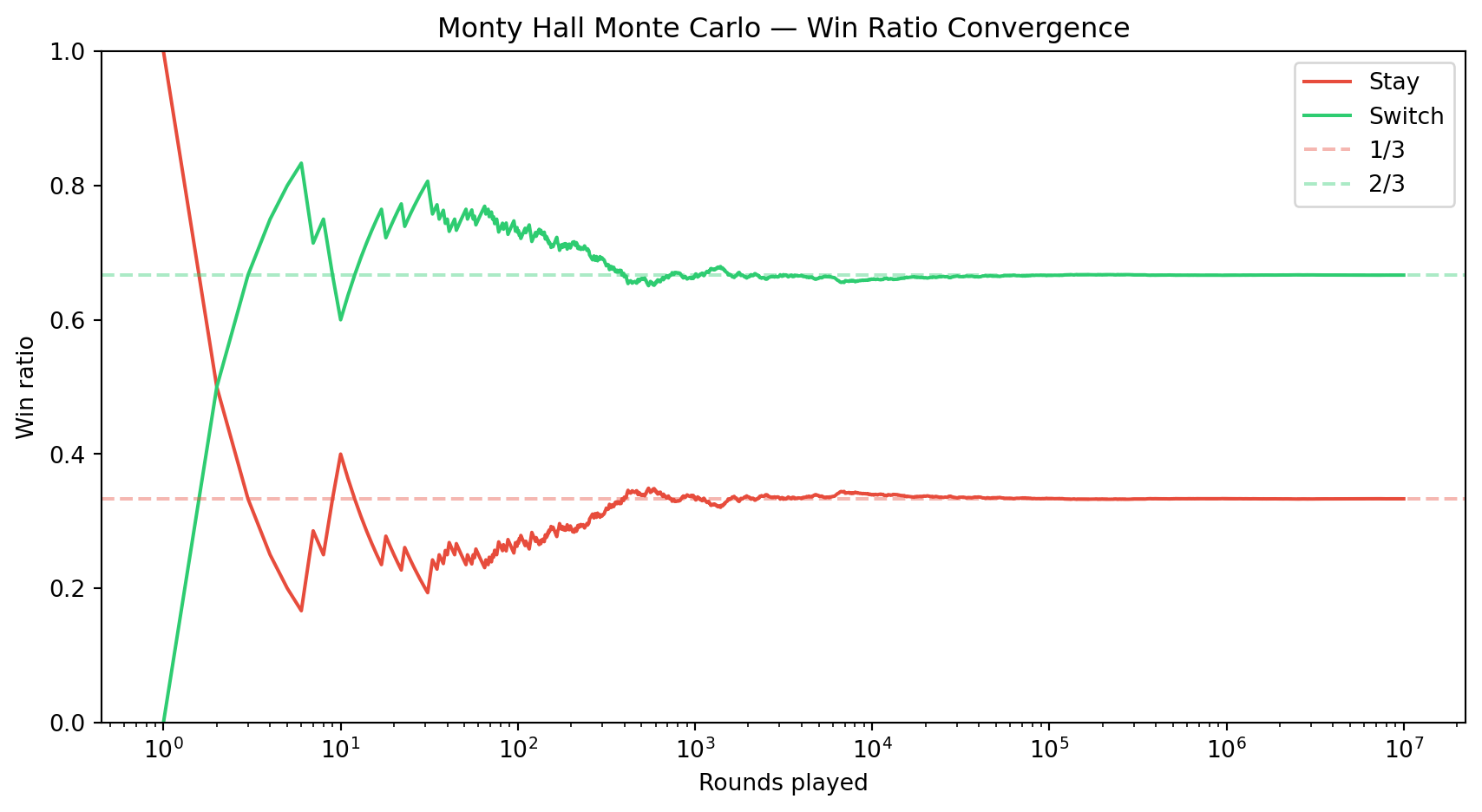
Want to run this locally? With uv installed:
uv run --with numpy --with matplotlib monty_hall.pyOr copy the code blocks above into a Jupyter notebook and experiment — try changing the number of doors, the bet amounts, or the number of rounds.