Making Money with Monty Hall
There’s a fun and notorious probability problem known as the Monty Hall problem. It’s famous for tripping up smart people. The setup is simple.
You’re on a game show and are presented with three closed doors: a prize behind 1 of the doors and non-prizes behind the other 2. Usually it’s a car behind one door and a goat behind each of the other two.
The rules: once you choose a door, one of the losing doors is revealed. After the reveal, you may switch your choice or keep it.
Assuming you want the prize, what strategy should you adopt? Should you stay or switch?
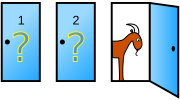
Illustration by Cepheus, via Wikimedia Commons. Public domain.

A common source of confusion is that the problem only works as stated because the host knows where the car is and always deliberately reveals a goat. This is part of the rules. The host is not opening a random door and getting lucky — the reveal is always informative about the other doors, never about yours. If the host opened doors randomly and happened to show a goat, the odds really would be 50-50.
Turns out, you should switch. You have a 2/3 chance of winning by switching, and only a 1/3 chance if you stay.
It’s a notorious problem because most people — especially somewhat math-inclined people — are tempted to reject the answer. They insist the odds are 50-50.
The YouTube Argument
There’s a YouTube video that mentions the Monty Hall problem and the correct solution. A commenter insisted the real odds are 50-50 — and confronted with the possibility that someone is wrong on the internet — I engaged.
After a lot of back and forth, the last volley was:
I don’t forget that the door is removed — and it isn’t just removed, it’s revealed — and that is crucial to why a person should switch.
(a) If you happened to have picked a door with a goat, when the only other goat is revealed, you are guaranteed to win the car if you switch.
(b) And since you agree that 2/3 of the time you will pick a door with a goat, it follows by necessity that switching will win you the car 2/3 of the time.
It’s not opinion, it’s math.
Its opinioinated math. There are two doors left. NOT THREE. Its now 50% chnace the car is behind door 1, and 50% its behind door 3, thats simple math.
Who cares when you made the choice? It does not affect the outcome.
You have fallen prey to a fallacy. Count the doors before you switch. 2 doors, and there is nothing magical making one more likely. Its simple logic. Your maths works fine, your logic is shit.
2/3 of the time you chose a door with a goat, and 1 goat is revealed, so its now 1/2 times you chose a goat. Got it you removed one door, you did not alter your math. Redo the math based on the current situation, not the historical situation.
2 doors, not three — the removed door boosts your choice just as much as the alternate door.
So: wrong, impervious to correction, and publicly proclaiming he’s right at my expense. The way I deal with these situations is to make a bet. Even if he won’t change his mind, he’ll get punished monetarily for holding false and uncorrectable beliefs. It’s win-win as far as I’m concerned.
The Bet
Since this commenter thinks the odds are 50-50 whether you switch or stay, and I think they’re 2/3 vs. 1/3 for switching, we pay each other depending on whose strategy wins each round:
| Outcome | Payout |
|---|---|
| Staying wins (Door 1 had the car) | I pay him $1.08 |
| Switching wins (Door 2 or 3 had the car) | He pays me $1.00 |
That’s an 8% payout difference on what he thinks is a coin flip — and if he’s got conviction, he should really want to play as many times as possible.
How the rounds work
Using a random number generator to determine which door hides the prize each round:
- We both always pick Door 1 to start.
- One goat door is revealed (from Door 2 or 3).
- I am forced to switch to the remaining closed door. He is forced to stay with Door 1.
- Whoever picked the right door gets paid by the other.
First 10 rounds
Using the first 10 random prize placements:
| Round | Prize behind | What happens | Result | My running total |
|---|---|---|---|---|
| 1 | Door 2 | Door 3 revealed → I switch to Door 2 → win | +$1.00 | +$1.00 |
| 2 | Door 3 | Door 2 revealed → I switch to Door 3 → win | +$1.00 | +$2.00 |
| 3 | Door 1 | A goat revealed → I switch away → lose | −$1.08 | +$0.92 |
| 4 | Door 2 | Door 3 revealed → I switch to Door 2 → win | +$1.00 | +$1.92 |
| 5 | Door 3 | Door 2 revealed → I switch to Door 3 → win | +$1.00 | +$2.92 |
| 6 | Door 1 | A goat revealed → I switch away → lose | −$1.08 | +$1.84 |
| 7 | Door 3 | Door 2 revealed → I switch to Door 3 → win | +$1.00 | +$2.84 |
| 8 | Door 1 | A goat revealed → I switch away → lose | −$1.08 | +$1.76 |
| 9 | Door 3 | Door 2 revealed → I switch to Door 3 → win | +$1.00 | +$2.76 |
| 10 | Door 1 | A goat revealed → I switch away → lose | −$1.08 | +$1.68 |
After 10 rounds: 6 wins, 4 losses — right in line with the 2/3 prediction — and I’m up $1.68.
How many rounds would you like to play? A thousand? A million? Ten million? I’ll play until someone goes bankrupt. Or let the computer play ten million rounds for you.